4 hours ago
Love Against the System: How "Dreamers" Transforms Immigration Into a Queer Love Story
READ TIME: 6 MIN.
There are moments in life that crystallize everything—that sit with you, reshape you, and eventually demand to be told. For filmmaker Joy Gharoro-Akpojotor, that moment came at 25 years old, sitting in a Home Office in Croydon, when an immigration officer asked her a question so reductive, so absurd in its cruelty, that it would eventually become the emotional core of her directorial debut. "How are you gay?" the officer demanded.
That dehumanizing question—the casual violence of being asked to prove an intrinsic part of your identity to a stranger with the power to determine your fate—became the seed for "Dreamers," a film that refuses to let audiences remain comfortable with how we discuss immigration. Instead of statistics and political rhetoric, Gharoro-Akpojotor offers something far more dangerous to the status quo: a love story.
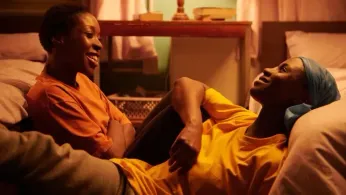
"Dreamers" follows Isio, a Nigerian migrant played by Ronkẹ Adékoluẹjo, who has been living undocumented in the UK for two years before being detained. When she's sent to a removal centre called Hatchworth, she meets Farah, a charismatic woman played by Ann Akinjirin, who challenges everything Isio believes about survival within the system.
What makes this film particularly resonant for queer audiences is its refusal to separate Isio's queerness from her immigration status. These aren't two separate struggles—they're interwoven, inseparable, and the film treats both with the complexity they deserve. Gharoro-Akpojotor didn't set out to make a film about immigration or a queer love story; she made a film where those identities are inextricable, where the personal becomes political without ever feeling didactic.
What distinguishes "Dreamers" from other films tackling immigration is its autobiographical foundation. Gharoro-Akpojotor didn't imagine this story from the outside—she lived it. Her own asylum journey, her own encounters with a system designed to dehumanize and compartmentalize human beings, forms the emotional bedrock of the narrative.
In a recent interview with DIVA, Gharoro-Akpojotor explained her motivation: "When I was 25, I sought asylum in the UK because of my sexuality. I'll never forget sitting in the Home Office in Croydon, surrounded by people desperately trying to explain why they deserved safety, and being asked by an officer, 'How are you gay? 'It was a moment that crystallised how impersonal and dehumanising the system could be. "
Rather than shy away from this personal connection, Gharoro-Akpojotor leaned into it. She wanted to humanize asylum seekers in a way that mainstream media rarely does. "I wanted to create a film that humanises people seeking asylum, to remind audiences that behind every statistic or headline is a person with hope, fear, and love," she explained.
This is crucial. In an era where immigration is "reduced to rhetoric – to numbers, to fear, to politics," as Gharoro-Akpojotor notes, "Dreamers" offers what she calls a counter-narrative. It invites audiences to experience immigration not as a policy debate but as a human story—one rooted in love, empathy, and the messy, complicated reality of two people trying to hold onto each other while the world conspires to tear them apart.
The film's emotional authenticity doesn't happen by accident. It's the result of meticulous preparation, trust-building, and a director who understood that to tell this story well, the actors needed to feel safe exploring vulnerability.
Ronkẹ Adékoluẹjo and Ann Akinjirin, who play Isio and Farah respectively, brought their own chemistry and history to the project. Both actors had known each other and Gharoro-Akpojotor for years before filming began, which created a foundation of trust that proved invaluable. "Both Ann and I have known each other and Joy for a long time. But luckily, we had a great rehearsal period in the location where we shot the entire film," Adékoluẹjo shared.
The production also employed an intimacy coordinator, El Wood, whose expertise helped guide the actors through scenes of physical and emotional intimacy. Rather than making the process clinical or uncomfortable, Wood's approach allowed the actors to explore their characters' connection authentically. Adékoluẹjo recalled, "We also had an astronomical intimacy coordinator, El Wood, whose practices and coaching allowed our characters to explore each other more intimately."
Beyond formal rehearsals, the cast and crew fostered connection in everyday moments. Adékoluẹjo enlisted her mother to cook for everyone on set, and Akinjirin hosted a games night at her home. These weren't just nice gestures—they were deliberate acts of community-building that translated into the warmth audiences see on screen. "Every day there was laughter, it's a love story after all," Adékoluẹjo noted.
Gharoro-Akpojotor's directorial choices extend beyond performance into the visual language of the film itself. Working with her cinematographer Anna Patarakina and production designer Gini Godwin, she made a deliberate decision to infuse "Dreamers" with color and warmth—a radical act when telling a story set in a removal centre.
"One thing that I was very clear about saying was, 'This is a love story and it's going to be colourful,'" Gharoro-Akpojotor explained in an interview. The room where Isio and Farah spend their time becomes increasingly warm as their relationship deepens, symbolizing their emotional connection. The peak of this visual metaphor arrives in a dream sequence depicting the imagined future they might build together—a house, a life, a possibility that exists only in their minds.
This aesthetic choice carries weight. By making their love visually stunning and emotionally luminous, Gharoro-Akpojotor refuses to let the system diminish their humanity. The color palette becomes an act of resistance, a visual declaration that these women's love matters, that their dreams matter, even—or especially—when the world tells them otherwise.
Gharoro-Akpojotor didn't create "Dreamers" in a vacuum. She drew inspiration from the queer filmmakers and storytellers who came before her, particularly producer Christine Vachon, whose work with director Todd Haynes shaped her vision of what queer cinema could be. "When I was first thinking about becoming a producer, I didn't really know what the hell that meant, "Gharoro-Akpojotor reflected.
Television also shaped her sensibilities. Shows like "Bad Girls," a British prison drama featuring a lesbian couple, and "The L Word," which centered multiple queer women's stories, provided blueprints for how to portray queer lives with complexity and nuance. "When I saw them I was like, 'I want to do that!'" she said.
"Dreamers" arrives at a cultural moment when immigration remains a flashpoint in political discourse across the globe. The film's refusal to engage with immigration as an abstract policy question—instead centering the lived experience of two queer women—offers a necessary corrective to how these conversations typically unfold.
By making audiences invest emotionally in Isio and Farah's relationship, Gharoro-Akpojotor accomplishes something that statistics and policy papers rarely can: she makes the stakes personal. She forces viewers to confront their own assumptions about who deserves safety, who deserves love, and what we owe to people seeking refuge in our countries.
The film had its world premiere at the 75th Berlin International Film Festival in February 2025, where it was selected for competition in the prestigious Teddy Award, recognizing excellence in LGBTQ+ cinema. Now, as it prepares for its UK theatrical release on December 5, 2025, "Dreamers" stands poised to reach audiences who need to see it most.
"Dreamers" is essential viewing for queer audiences because it refuses to compartmentalize our identities or our struggles. It acknowledges that queerness and immigration status are not separate issues to be addressed in isolation—they're interconnected realities that shape how people move through the world, how they're treated by institutions, and how they find love and community in the margins.
For a community accustomed to seeing our stories flattened into digestible narratives or stripped of political context, "Dreamers"offers something different: a film that trusts its audience to hold complexity, to sit with discomfort, and to emerge with their understanding of immigration—and of queer resilience—fundamentally shifted.
As Gharoro-Akpojotor said, "If viewers leave frustrated, that reflects the reality many asylum seekers face daily." That's not a bug in the film's design—it's the entire point. "Dreamers" wants you to feel something. It wants you to be moved, challenged, and changed by witnessing Isio and Farah's love story. And in doing so, it asks you to reconsider everything you thought you knew about immigration, asylum, and the power of love to transcend bureaucracy and borders.